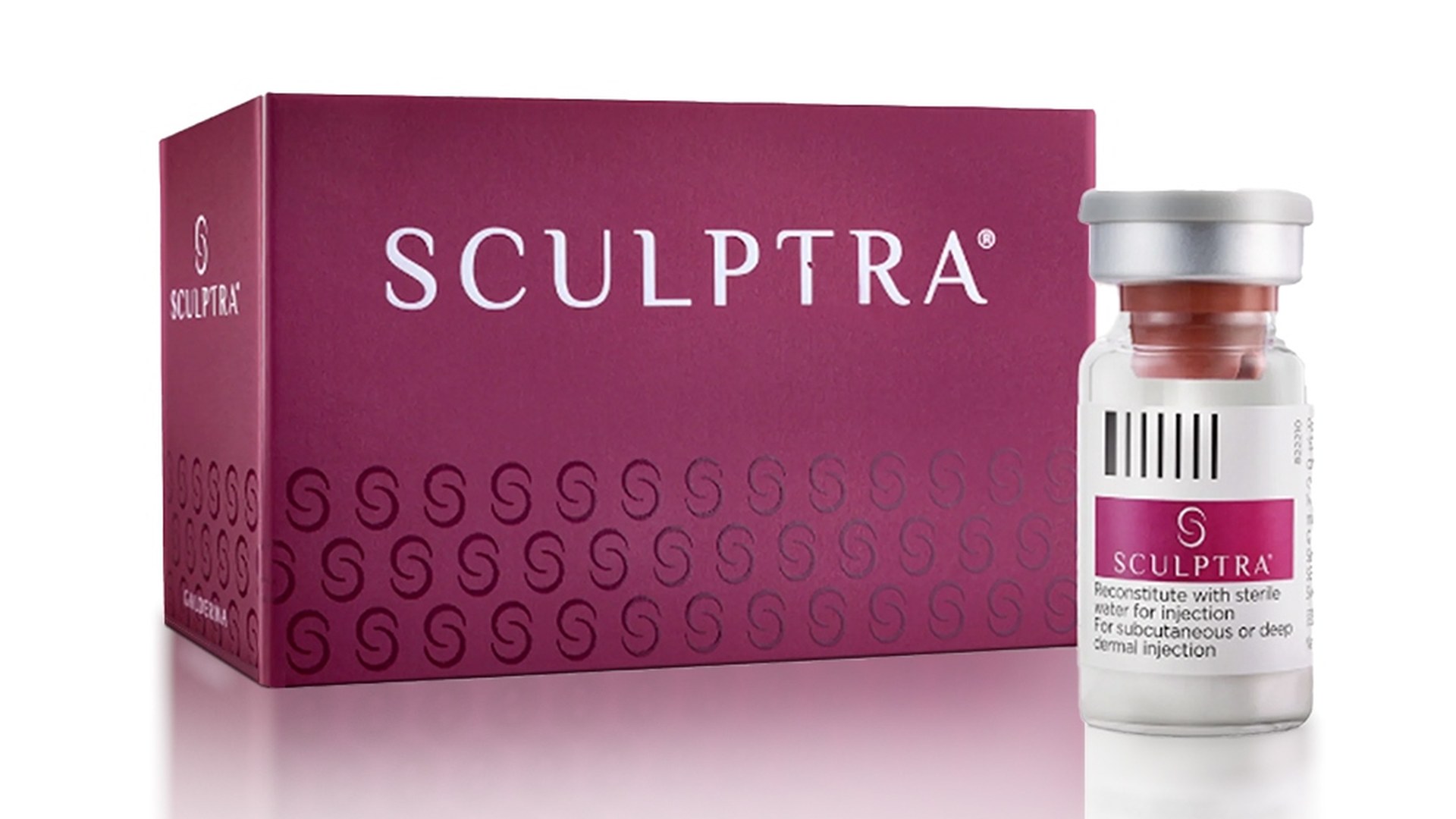
The short answer: hyaluronic acid (HA) fillers like Juvederm and Restylane add volume to your face the moment they're injected by physically filling the space under your skin. Sculptra is different — it's a biostimulator that triggers your body to grow its own collagen over several months, gradually rebuilding lost facial structure. HA fillers give you immediate, reversible results that last 6 to 18 months. Sculptra builds slower, longer-lasting volume that can last up to 2 to 3 years.
If you're trying to decide between them — or wondering why your aesthetic provider recommended one over the other — this guide breaks down exactly how each works, who each is best for, and how to think about the tradeoffs.
Quick Answer
- HA fillers (Juvederm, Restylane, Belotero, RHA) — Hyaluronic acid gel that physically adds volume on contact. Results are immediate, last 6 to 18 months, and can be dissolved with hyaluronidase if needed.
- Sculptra — Poly-L-lactic acid (PLLA) that stimulates your own collagen production over 3 to 6 months. Results build gradually, look natural, and last up to 2 to 3 years. Cannot be dissolved.
- HA fillers are best for sculpting specific features — lips, cheeks, jawline, tear troughs, nasolabial folds.
- Sculptra is best for full-face volume restoration, midface hollowing, temples, and overall skin quality improvement.
How Hyaluronic Acid Fillers Work
Hyaluronic acid is a sugar molecule that occurs naturally in your skin, where it binds water and contributes to volume and hydration. Cross-linked HA gel fillers are injected under the skin, where they physically occupy space, lifting and reshaping the area immediately.
Different HA filler products are formulated for specific tissue depths and goals. Lighter formulations like Volbella, Restylane Kysse, and RHA 2 are used in thin tissue like lips and tear troughs. Stiffer formulations like Voluma, Restylane Lyft, and RHA 4 are used for deep cheek and jawline projection.
HA fillers gradually break down over 6 to 18 months as your body metabolizes the gel. They are also reversible — an enzyme called hyaluronidase can dissolve HA filler within hours if results need to be adjusted or undone.
How Sculptra Works
Sculptra is poly-L-lactic acid (PLLA), a biocompatible material used in medicine for decades (it's the same material used in dissolvable sutures). When injected under the skin, the PLLA microparticles trigger a controlled wound-healing response that stimulates fibroblasts to produce new collagen — the structural protein that gives skin firmness, thickness, and lift.
Because Sculptra works by collagen induction, results are not immediate. The injected liquid is largely absorbed within a few days, and visible improvement develops gradually over 6 to 12 weeks as new collagen forms. Most patients receive a series of 2 to 4 sessions spaced about 4 to 6 weeks apart to build cumulative results.
Once collagen has formed, the results last significantly longer than HA fillers — typically 2 to 3 years — and improve overall skin quality, not just volume.
Sculptra vs HA Fillers — Side by Side
- Material: Sculptra is poly-L-lactic acid (a collagen biostimulator). HA fillers are cross-linked hyaluronic acid gel.
- Mechanism: Sculptra triggers your body to make new collagen. HA fillers physically add volume on contact.
- Onset: Sculptra takes 6 to 12 weeks to show results. HA fillers are visible immediately.
- Duration: Sculptra lasts 2 to 3 years. HA fillers last 6 to 18 months depending on the product and area.
- Reversibility: HA fillers can be dissolved with hyaluronidase. Sculptra cannot be dissolved.
- Number of sessions: Sculptra usually requires 2 to 4 sessions. HA fillers are typically a single session per area.
- Best for: Sculptra is best for global volume loss, hollow temples, midface flattening, and overall skin quality. HA fillers are best for precise feature sculpting (lips, cheekbones, jawline, tear troughs).
- Look and feel: Sculptra produces a natural, structural, 'lifted from within' result. HA fillers can produce more defined contour and projection.
Which One Is Right for You?
Choose HA Fillers If You Want:
- Immediate, visible results from a single session
- Precise sculpting of lips, cheeks, jawline, chin, or tear troughs
- Reversibility — the option to dissolve the product if you change your mind
- A more conservative first step before considering biostimulators
Choose Sculptra If You Want:
- Global facial volume restoration after weight loss, GLP-1 medications, or aging
- A natural, gradual improvement that doesn't look 'done'
- Longer-lasting results — up to 2 to 3 years
- Improved skin firmness and quality, not just added volume
- Treatment of areas with diffuse volume loss like temples or midface
Can They Be Used Together?
Yes — and frequently they should be. Many treatment plans combine Sculptra to rebuild the underlying foundation of facial volume with HA fillers to refine specific features once that foundation is in place. For example, a patient with significant midface volume loss may benefit from Sculptra in the cheeks and temples first, followed by HA filler in the lips or jawline a few months later for definition.
An experienced injector will assess your facial anatomy, goals, and timeline to recommend the right combination — a plan mapped to your face, not a generic template.
Are There Risks?
Both treatments are FDA-approved and have strong long-term safety records when performed by qualified medical providers. Common temporary side effects include swelling, bruising, redness, and tenderness at injection sites.
HA filler-specific risks include lumps, asymmetry, and rare vascular complications — most of which are correctable because the product can be dissolved.
Sculptra-specific risks include delayed nodules if the product is improperly diluted or massaged after treatment. Choosing an experienced, board-certified injector who uses appropriate dilution and technique dramatically reduces this risk.
Cost Comparison
HA filler is typically priced per syringe ($600 to $1,200 per syringe, depending on product and provider). Most patients need 1 to 3 syringes per area, depending on the goal.
Sculptra is priced per vial ($800 to $1,200 per vial). Most patients need 2 to 4 vials over a treatment series, with results that last 2 to 3 years — often making the cost-per-year of Sculptra comparable to or lower than recurring HA filler maintenance.
Frequently Asked Questions
Is Sculptra better than fillers?
Neither is universally 'better' — they do different things. Sculptra is better for restoring overall facial volume gradually and naturally. HA fillers are better for precise feature sculpting with immediate results. Most thoughtful aesthetic plans use both.
How long does Sculptra last compared to HA filler?
Sculptra typically lasts 2 to 3 years once a full treatment series is complete. HA fillers last 6 to 18 months depending on the product and area treated.
Can Sculptra be reversed?
No. Unlike HA fillers, Sculptra cannot be dissolved. This is why it's important to be treated by an experienced injector who applies it conservatively and builds results gradually.
Will I see results immediately with Sculptra?
No. The initial volume from the injection liquid disappears within a few days. Visible improvement from new collagen develops over 6 to 12 weeks and continues to improve for up to 6 months.
Is Sculptra safe?
Yes. Sculptra has been FDA-approved since 2004 and is widely used. Like all injectables, safety depends heavily on the experience and technique of the injector.
What's the best filler for under the eyes?
HA fillers are typically the first choice for tear troughs because they can be precisely placed in this delicate area and dissolved if needed. Sculptra is generally not used directly in the tear trough area.
Can Sculptra fix Ozempic face?
Yes — Sculptra is one of the most commonly recommended treatments for facial volume loss after rapid weight loss from GLP-1 medications, because it rebuilds underlying volume and skin quality rather than just spot-filling individual hollows.
The Bottom Line
HA fillers and Sculptra are not competitors — they are different tools for different goals. HA fillers reshape and define features instantly with reversible results. Sculptra rebuilds lost facial volume gradually with longer-lasting, more natural-looking results. The best plan often uses both, sequenced thoughtfully and tailored to your anatomy and timeline.
If you're trying to decide between them, the most useful next step is a consultation with a board-certified injector who can assess your face in three dimensions and explain which option — or which combination — best fits your goals.